

In the wake of the murder of George Floyd, there’s a lot of talk about systemic racism, especially in regards to the criminal justice system. What does that mean? Though some may disagree, it does not mean (nor am I implying) that police officers are racist. Statistically speaking, some are racist, most are not. That said, what systemic racism means is that the criminal justice system is tilted against Black Americans. Let’s investigate if that is indeed the case.
The Data
Traffic Stops
As many public interactions with police are a result of traffic stops, it’s useful to examine the data from the Bureau of Justice Police-Public Reports on Traffic Stops.
The table below lays out traffic and street stops as a percentage of all contacts with police. For context, white Americans make up 67% of the total driving population, and Black Americans make up 11%. Six times as many white Americans driving as Black.
Overall, 8.6% of all contacts with police were a result of traffic stops, 2.4% with the passenger was part of the stop, and 1% were from street stops. Also important is the number of arrests that resulted from the stops.

Nearly ten percent of Black drivers were subjected to traffic stops in 2015, compared to 8.6% for whites. Also notable are the higher percentage of street stops and the arrest rate.
EDIT: As one of my intrepid readers so gleefully observed while accusing this post of being slanted, whites are stopped 5 times as much as blacks. But the spreadsheet only shows a percentage of drivers of a race being stopped to make you think that’s an issue. Of course, he didn’t fully do the math. There are 6 times as many white drivers as black drivers so you’d expect if all things were equal, there would be 6 times as many traffic stops.,..not 5 times as many. Still not equal so the point is still valid.
Non-lethal Use of Force
With the increased police interactions, the next question is how are those interactions handled. A study by economist Roland G. Fryer, Jr. provides some insight.
“The results obtained using these data are informative and, in some cases, startling. Using data on police interactions from NYC’s Stop and Frisk program, we demonstrate that on non-lethal uses of force – putting hands on civilians (which includes slapping or grabbing) or pushing individuals into a wall or onto the ground, there are large racial differences. In the raw data, blacks and Hispanics are more than fifty percent more likely to have an interaction with police which involves any use of force.
An Emperical Analysis of Racial Differences in Police Use of Force
Roland G. Fryer, Jr.
The study found that the results were consistent across various data sets (different police departments).
Unarmed Fatal Interactions with Police
In Part I of this series, I presented a study that showed 20% of all fatal encounters with police involve unarmed citizens. That review also focused on race-gender differences in fatal encounters with police.
Using hierarchical linear models, we find the odds that black Americans will be killed by police when unarmed are nearly 7 to 1—more than double the odds found in research to date—and due primarily to the unarmed status of black women.
“Race, Gender and the Contexts of Unarmed Fatal Interactions with Police” Johnson Jr, Gilbert, Ibrahim[cm_simple_footnote id=”1″]
A government study published in 2018 titled “Deaths Due to Use of Lethal Force by Law Enforcement“[cm_simple_footnote id=”2”] concluded:
Victims were majority white (52%) but disproportionately black (32%) with a fatality rate 2.8 times higher among blacks than whites. Most victims were reported to be armed (83%); however, black victims were more likely to be unarmed (14.8%) than white (9.4%) or Hispanic (5.8%) victims.
One thing of note, the data used in the first study presented was from 2013-2015, the 2nd was from 2009-2012, which may account for the statistical discrepancies. Nonetheless, it is clear from both studies than unarmed black males are far more likely to die at the hands of law enforcement than whites or Hispanics.
The Washington Post compiled a database on lethal use of force by law enforcement from 2015-2019 (unfortunately behind a paywall), but this graphic from their study shows the same pattern.

Drug Arrests/Convictions
Whites and blacks use illegal drugs in roughly equal numbers relative to percentage of population[cm_simple_footnote id=”3″].

Side rant: While researching these statistics, the most useful site for crime demographics was the FBI’s Crime in the United States 2018. It has all the demographic information you’d want for all crimes with one notable exception… drug arrests. This was the only demographic provided there…which is utterly useless.
However, the Bureau of Justice provides incarceration rates for drug offenses. The spreadsheet shown below shows that blacks as a percentage are once again higher than whites.

This pattern is repeated with cannabis, a non-addictive drug, and one that most rational people don’t consider dangerous (with many states decriminalizing or legalizing marijuana for recreational use). Below is a chart showing drug usage statistics comparison by race from the Substance Abuse and Mental Health Services Administration (SAMHSA).

Now compare that to arrests by race using the FBI Uniform Crime Reporting.
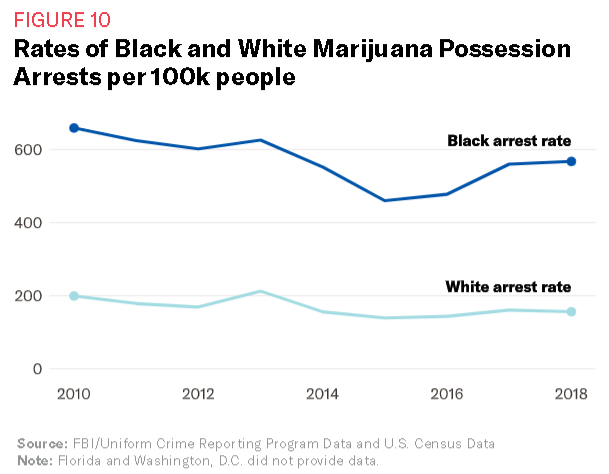
Gee, the use and arrest/convictions doesn’t line up, does it?
What is both interesting and disturbing are the trends regarding drug arrests. Arrests for drug possession of increased while arrests for drug sale/manufacturing have been flat since 1997. This image from an analysis of the Bureau of Justice Statistics and Uniform Crime Report.[cm_simple_footnote id=”4″]

Civil Asset Forfeiture
The abuses of civil asset forfeiture have been widely reported. Civil asset forfeiture has been proven to disproportionately affect minorities and the poor. There are numerous studies and reports on this issue here, here, and here. With Philadelphia as the poster child for civil asset forfeiture abuse, here.
In 2018, a consent decree agreement with the City of Philadelphia was announced. The result of that agreement is that the city will have tight restrictions on when they can seize assets. It was further agreed that the city would pay reparations to those victimized by civil asset forfeiture.[cm_simple_footnote id=”5″]
Conclusion
I went into researching this post with an open mind. The goal was to analyze the raw data, consult scholarly studies, and form a rational position based on the data.
This post examined traffic stops, non-lethal use of force, fatal interactions with police, and drug arrest convictions/incarceration rates. It also touched on civil asset forfeiture and who is most affected by it. The totality of the evidence is simultaneously enlightening and depressing.
While Mark Twain famously popularized the saying, “lies, damn lies and statistics,” the data is pretty damning when it comes to the existence of systemic racism in our criminal justice system.
The big question is “why?”. That is something I’ll tackle in Part III.

 The Pragmatic Libertarian