Category Archives: Police Brutality

Causes of Systemic Racism

In my last post about systemic racism, I provided ample evidence that there is indeed systemic racism in the criminal justice system. That said, it’s don’t hate the playa, hate the game. What that means is that I’m not blaming law enforcement officers as much as the system. The laws themselves are biased; cops have too much power and little accountability. This is the system they work within.

Population Density and the Inner City

As a few readers pointed out in the last post, some of the data can be due to Black Americans living in higher density areas. Now you may be thinking, “How does that contribute to systemic racism?” Without going too deep down the rabbit hole, the clustering Black Americans together is not an accident. The federal government created much of that problem with racist housing regulations. [cm_simple_footnote id=”1a”][cm_simple_footnote id=”2″]

The clustering can best be visualized by looking at the Racial Dot Map. What is clear in many cities is the sharp dividing line between black and white (Detroit as a prime example).

Implicit Bias

There have been many hypotheses as to why there is systemic racism; one of the more recent theories has been implicit bias. In a study[cm_simple_footnote id=”3″] by Michael Siegel M.D., M.P.H., he used data on fatal police shootings and ran it against five key indicators of systemic racism in each state; racial segregation, incarceration rate gaps, educational attainment gaps, the economic disparity index, and employment disparity gaps. He concluded:

Our findings provide evidence that both the threat hypothesis and the community violence hypothesis are contributing to the explanation of the striking racial disparity in police shootings of unarmed suspects. 

The Relationship Between Structural Racism and Black-White Disparities in Fatal Police Shootings at the State Level
Michael Siegel M.D., M.P.H.

Officer Performance Rating

Another factor listed as part of the cause is how police officers are rated as part of their performance. While quotas are illegal in most states, officers are still required to write tickets and make misdemeanor arrests (for things like drug possession). The loophole is that such metrics may be considered as a part of an officer’s overall performance review. Not reduced crime. Not reduced accidents. Not reduced complaints. Not improved community relations. Tickets and arrests. Why? Revenue generation. Law enforcement officials are less concerned with community relations and reduced crime than they are generating revenue for their agency.[cm_simple_footnote id=”4″]

Many cities have come under fire for such policies, including New York and their infamous “stop-and-frisk” policy. In 2012, Officer Craig Matthews spoke out about the policy saying:

…causing unjustified stops, arrests, and summonses because police officers felt forced to abandon their discretion in order to meet their numbers.

Officer Craig Matthews, NYPD

Consequently, the city retaliated against Officer Matthews by “punitive assignments, denial of overtime and leave, separation from his career-long partner, humiliating treatment by supervisors, and negative performance evaluations.” as claimed in a lawsuit Officer Matthews filed against the city.[cm_simple_footnote id=”5″] In 2015, the city settled the lawsuit for $280,000.[cm_simple_footnote id=”6″]

While these tactics may go unnoticed in the suburbs where the population is less dense, it becomes more problematic where the population is more racially dense. This effect was called out in the DOJ’s Ferguson Report.[cm_simple_footnote id=”7″] Officers assigned to the more racially dense Black neighborhoods, will naturally write more tickets and make more arrests of black Americans.

Conclusion

Systemic racism is not caused by any one factor, but a combination of many. I began with population density of Black Americans for a reason. It is that density that has some cascade effects down the line. Implicit bias and ticket quotas all feed into the population density and clustering that was baked into the system early on.

While these other factors may have a role, the single biggest factor of systemic racism in the criminal justice system is the War on Drugs. The Drug War from it’s inception in 1930 was specifically targeted against Black Americans. The War on Drugs was sold to white America using racist terms and imagery, and the laws were targeted toward Black Americans. Accordingly, the criminal justice system used the power they were granted to devastating effect. Exactly how it was designed

To better understand the War on Drugs, it is necessary to dig into the history of the Drug War. How the war began, who were the major players behind it, and the lasting effects it has today. That is something for Part IV.

Systemic Racism?

In the wake of the murder of George Floyd, there’s a lot of talk about systemic racism, especially in regards to the criminal justice system. What does that mean? Though some may disagree, it does not mean (nor am I implying) that police officers are racist. Statistically speaking, some are racist, most are not. That said, what systemic racism means is that the criminal justice system is tilted against Black Americans. Let’s investigate if that is indeed the case.

The Data

Traffic Stops

As many public interactions with police are a result of traffic stops, it’s useful to examine the data from the Bureau of Justice Police-Public Reports on Traffic Stops.

The table below lays out traffic and street stops as a percentage of all contacts with police. For context, white Americans make up 67% of the total driving population, and Black Americans make up 11%. Six times as many white Americans driving as Black.

Overall, 8.6% of all contacts with police were a result of traffic stops, 2.4% with the passenger was part of the stop, and 1% were from street stops. Also important is the number of arrests that resulted from the stops.

Nearly ten percent of Black drivers were subjected to traffic stops in 2015, compared to 8.6% for whites. Also notable are the higher percentage of street stops and the arrest rate.

EDIT: As one of my intrepid readers so gleefully observed while accusing this post of being slanted, whites are stopped 5 times as much as blacks. But the spreadsheet only shows a percentage of drivers of a race being stopped to make you think that’s an issue. Of course, he didn’t fully do the math. There are 6 times as many white drivers as black drivers so you’d expect if all things were equal, there would be 6 times as many traffic stops.,..not 5 times as many. Still not equal so the point is still valid.

Non-lethal Use of Force

With the increased police interactions, the next question is how are those interactions handled. A study by economist Roland G. Fryer, Jr. provides some insight.

“The results obtained using these data are informative and, in some cases, startling. Using data on police interactions from NYC’s Stop and Frisk program, we demonstrate that on non-lethal uses of force – putting hands on civilians (which includes slapping or grabbing) or pushing individuals into a wall or onto the ground, there are large racial differences. In the raw data, blacks and Hispanics are more than fifty percent more likely to have an interaction with police which involves any use of force.

An Emperical Analysis of Racial Differences in Police Use of Force
Roland G. Fryer, Jr.

The study found that the results were consistent across various data sets (different police departments).

Unarmed Fatal Interactions with Police

In Part I of this series, I presented a study that showed 20% of all fatal encounters with police involve unarmed citizens. That review also focused on race-gender differences in fatal encounters with police.

Using hierarchical linear models, we find the odds that black Americans will be killed by police when unarmed are nearly 7 to 1—more than double the odds found in research to date—and due primarily to the unarmed status of black women.

Race, Gender and the Contexts of Unarmed Fatal Interactions with Police” Johnson Jr, Gilbert, Ibrahim[cm_simple_footnote id=”1″]

A government study published in 2018 titled “Deaths Due to Use of Lethal Force by Law Enforcement“[cm_simple_footnote id=”2”] concluded:

Victims were majority white (52%) but disproportionately black (32%) with a fatality rate 2.8 times higher among blacks than whites. Most victims were reported to be armed (83%); however, black victims were more likely to be unarmed (14.8%) than white (9.4%) or Hispanic (5.8%) victims.

One thing of note, the data used in the first study presented was from 2013-2015, the 2nd was from 2009-2012, which may account for the statistical discrepancies. Nonetheless, it is clear from both studies than unarmed black males are far more likely to die at the hands of law enforcement than whites or Hispanics.

The Washington Post compiled a database on lethal use of force by law enforcement from 2015-2019 (unfortunately behind a paywall), but this graphic from their study shows the same pattern.

Drug Arrests/Convictions

Whites and blacks use illegal drugs in roughly equal numbers relative to percentage of population[cm_simple_footnote id=”3″].

Side rant: While researching these statistics, the most useful site for crime demographics was the FBI’s Crime in the United States 2018. It has all the demographic information you’d want for all crimes with one notable exception… drug arrests. This was the only demographic provided there…which is utterly useless. 

However, the Bureau of Justice provides incarceration rates for drug offenses. The spreadsheet shown below shows that blacks as a percentage are once again higher than whites.

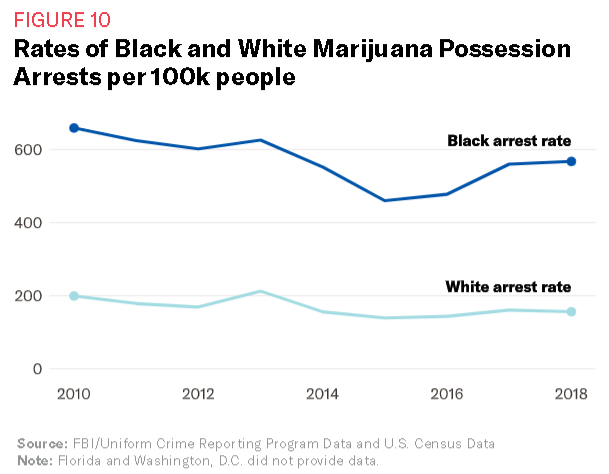
This pattern is repeated with cannabis, a non-addictive drug, and one that most rational people don’t consider dangerous (with many states decriminalizing or legalizing marijuana for recreational use). Below is a chart showing drug usage statistics comparison by race from the Substance Abuse and Mental Health Services Administration (SAMHSA).

Now compare that to arrests by race using the FBI Uniform Crime Reporting.

Gee, the use and arrest/convictions doesn’t line up, does it?

What is both interesting and disturbing are the trends regarding drug arrests. Arrests for drug possession of increased while arrests for drug sale/manufacturing have been flat since 1997. This image from an analysis of the Bureau of Justice Statistics and Uniform Crime Report.[cm_simple_footnote id=”4″]

It’s almost like they’re not even trying to “stop” illegal drug sales.

Civil Asset Forfeiture

The abuses of civil asset forfeiture have been widely reported. Civil asset forfeiture has been proven to disproportionately affect minorities and the poor. There are numerous studies and reports on this issue here, here, and here. With Philadelphia as the poster child for civil asset forfeiture abuse, here.

In 2018, a consent decree agreement with the City of Philadelphia was announced. The result of that agreement is that the city will have tight restrictions on when they can seize assets. It was further agreed that the city would pay reparations to those victimized by civil asset forfeiture.[cm_simple_footnote id=”5″] 

Conclusion

I went into researching this post with an open mind. The goal was to analyze the raw data, consult scholarly studies, and form a rational position based on the data.

This post examined traffic stops, non-lethal use of force, fatal interactions with police, and drug arrest convictions/incarceration rates. It also touched on civil asset forfeiture and who is most affected by it. The totality of the evidence is simultaneously enlightening and depressing.

While Mark Twain famously popularized the saying, “lies, damn lies and statistics,” the data is pretty damning when it comes to the existence of systemic racism in our criminal justice system.

The big question is “why?”. That is something I’ll tackle in Part III.

The Murder of George Floyd – Minimization

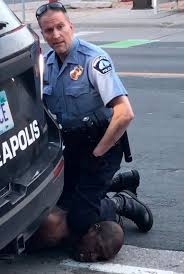
The murder of George Floyd at the hands of Minneapolis Police officer Derek Chauvin has aroused a range of emotions across the country. Some are sympathetic, some are enraged, some are defensive, and inexplicably…some are in outright denial. As it took me some time to carefully research and consider the facts before writing this post, it will be broken up into a series.

Victim-blaming

I’ve seen far too many people resort to victim-blaming to minimize what happened. It does not matter who George Floyd was, what his criminal history was, what drugs were in his system, and the reasons for his arrest. None of these things are the least bit relevant. Anyone making that claim is using a red herring logical fallacy. I’ve seen memes and commentators attempting to make that same point. As an example, Candace Owens went on a long rant about attacking George Floyd’s character which was brilliantly deconstructed by Larry Sharpe. [cm_simple_footnote id=”1″] Nobody is making George Floyd out to be a “hero” but he has become the face of a cause.

The fact of the matter is that law enforcement has a duty to the care and well-being of an individual in custody.[cm_simple_footnote id=”2″] [cm_simple_footnote id=”3″] Make no mistake, Floyd was in custody. He was lying prone while handcuffed. If he was resisting at some point off-camera (and I’ve seen and heard nothing that indicates he was), it’s pretty clear he had stopped. You simply cannot defend a police officer kneeling on a man’s neck for 8 minutes and 46 seconds by stating that the victim was not an upstanding citizen. He was a human being, a U.S. Citizen and at a minimum was entitled to due process for his alleged crime.

Unarmed White Individuals killed by law enforcement

The other common red herring I’d like to address are the posts, memes, and commentaries about unarmed white men being killed by law enforcement as a way to minimize the racial component and the BLM movement. Typically, these posts like to point out that people did not protest or riot (SIDE NOTE: Protesters are not rioters) over the deaths of unarmed white individuals (like Duncan Lemp, Daniel Shaver, Tony Timpa, and Kelly Thomas) at the hands of law enforcement. Well gee America, how noble of you to remain silent while your unarmed white brothers are killed by law enforcement. Where was your outrage when these men were killed at the hands of law enforcement? Where are the posts pointing out their criminal histories? Are you trying to say you didn’t care about those deaths but only care now to bring them to everyone’s attention because…”All Lives Matter.” Outside of civil libertarians, nobody else was showing outrage or concern that unarmed citizens have been and are being killed by law enforcement.

Missing the Point

All of these fallacious arguments miss the point. We should ALL be outraged when ANY individual dies at the hands of law enforcement while unarmed. Their criminal histories do not matter. Whatever drugs are alcohol they were on do not matter. More disturbing is the fact that 20% of all fatal encounters with police involve unarmed citizens.

Table 1 (see chart below) provides descriptive information of the agency sample and the sample of fatalities. Our samples reveal that a fifth (20%) of all fatalities were of unarmed individuals (column 3), and that they were committed by approximately 9 percent of the (law enforcement) agencies in our sample (column 1).

“Race, Gender and the Contexts of Unarmed Fatal Interactions with Police” Johnson Jr, Gilbert, Ibrahim[cm_simple_footnote id=”4″]

The first step in solving any problem is admitting there is a problem. Resorting to logical fallacies to minimize the problem is not going to solve a thing. At some point Americans need to come to terms with the facts on fatal police interactions. In my next post I’ll address the racial component and if there is systemic racism in law enforcement.

Part II