Author Archives: Pragmatic Libertarian

The Road Back to the LP

I’ve long been a small-l libertarian and 90% of the time a Big-L libertarian because they’re the best option for liberty. That isn’t to say that an average libertarian like me didn’t have problems with the LP.

If you read my first post here, I made an argument of principles versus pragmatism and took many in the LP to task for their poor and inconsistent messaging. You can guess how I feel about the present state of the party post-Mises Caucus takeover.

To briefly recap, at the end of May 2022, the Mises Caucus (hereafter known as MC) took over the party…sweeping all the top spots. Many were caught off-guard, but those in the party warned of the possibility. What most of us didn’t know is how hard right the party would turn.

We found out soon enough when the MC removed “bigotry is irrational and repugnant” from the plank. That was the first sign of things to come, and it drove many people from the LP, including myself. Why would they remove that from the plank? What could possibly be the goal? You can postulate that they’re openly courting racists, but I don’t know if that was really the goal. I think it’s far more insidious than that.

The MC Messaging Problem

If anyone has paid attention to the LPN, MC-friendly state affiliates, and MC members’ social media, the messaging most often is not libertarian. They are fully invested in fighting the culture war. If challenged, they block rather than engage in rational discourse because they don’t have a rational response.

This flawed messaging was ramped up with the ongoing war in Ukraine. The position of the LPN and MC is irrational. As a libertarian, it is possible to condemn Russia and defend Ukraine’s independence while being anti-war, anti-aid, and anti-foreign entanglements. That is not the message being sent by the MC. It supports Russia and assails Ukraine. Hell, at one point, they were defending the totalitarian theocracy in Iran. In what kind of upside-down libertarian world do we defend aggression? They’re repeating Fox News talking points. Why?

I think everyone knows why. They aren’t libertarians. They’re Trump supporters cosplaying as libertarians.

The point is, none of that matters.

The Epiphany

In the months following the MC takeover of the LPN, I probably went through all the stages of grief. I got active on Twitter, calling out the MC, and was subsequently blocked by a number of those on the National Committee, the MC, and one of the state affiliates. I raged on for a few months until I had an epiphany.

We lost to a group that behaves like irresponsible cringe edgelord teens. A group that supported 2 MAGA candidates over libertarian ones. We lost to THEM? A group that repeats Russian propaganda. We lost to THEM? A group that lost control of the LPN Twitter account. We lost to THEM? A group that has told people if they don’t like it to GTFO. We lost to THEM?

Their goal was to destroy the party. Look at their actions. They thrive on conflict and chaos. They’re running the fewest candidates in decades, which is the point of a political party. Donors have left, and they’re bleeding money. They want us to leave the party. I’ve donated and voted libertarian for nearly 30 years, only to give up because some children want me out? Oh, hell no.

The Realization

After I had that epiphany and some time to reflect, I came to a few realizations.

First, I had been sucked into their negative energy and playing their game. There’s nothing to be gained by raging away on my keyboard other than raising my blood pressure. If I call them out now, I do so with a rational libertarian response; not for me, but for anyone that reads and thinks their messaging is libertarian.

Secondly, many of us are angry. The rational libertarians, from ancaps to pragmatists, are a far larger coalition than I thought.

Thirdly, I and others like myself are partially to blame for this happening. My activity at the party has come and gone over the years. I took the party for granted. As much as I had a problem with the endless struggle between hardliners and pragmatists within the LP, we all ultimately came together for the same end goal, dramatically reducing government power and increasing liberty. With the LP ripped away, many of us felt adrift.

Finally, whatever damage is being done can be undone. The MC is tanking the party…that’s true. It doesn’t bode well for the few midterm candidates they’ve supported. We’ve all seen the messaging on social media. But we’re acutely aware because we follow all the children. To put things into perspective, the LPN Twitter account has 250k followers…that’s about 1/10 of the Democratic National and GOP accounts. Gary Johnson had the highest recognition at nearly 20%. A majority of Americans still don’t know anything about the LP or what it stands for. The truth of the matter is that libertarianism is still fringe, but we have an opportunity to change that.

What now?

I’m done sitting on the sidelines. While I’ve always been active on social media, that is not fully supporting the party. To that end, I have re-upped my state and national memberships and attended my first county meeting in years.

One thing is sure; if we’re on the outside and do nothing, we can’t affect change. We can take the anger and disgust and turn it into positive energy to flip it right back on them. Suppose all of the disenfranchised libertarians come back and bring new people with similar libertarian mindsets and put energy into those types of people. In that case, we can return the party to the adults in 2024. I’ve chosen to stand up for libertarianism and against authoritarianism. We have a plan. I hope you will join me in that cause and on Reddit at r/libertarian911.

COVID-19, Masks, Politics, and Authoritarianism.

Statists on either side of the coin take issue with libertarians when it comes to liberty. We unapologetically defend everyone’s freedom from state intrusion. Where that confuses people is that we’ll even defend freedom when the exercise of that freedom is hateful, self-harmful, or stupid. That doesn’t mean we’ll agree with the use of those freedoms, just that we’ll support the right.

The exercise of liberty does not mean the right to intrude on someone else’s freedom. Nor does it make someone free from consequences. If you’re a jerk, people may not want to be around you. They may not want to do business with you. It may cost you your job. These are all private consequences for exercising your freedom, and we’re ok with that as well.

So how does liberty fit in with individual and government reactions to COVID-19? Most certainly the severity of the virus and the issue of masks has been politicized. The government has also given citizens plenty of reasons to distrust it. Does the politicization of COVID-19 square with the dangers and efficacy of face masks?

Masks and Politics

The issue of wearing a mask has been controversial since the beginning. First, the CDC flip-flopping on whether people should wear a mask. Fauci explained the rationale was that they didn’t want a run on masks that should go to government personnel. That seems to be flawed reasoning because if masks could cut down on transmission, then medical staff wouldn’t be so overwhelmed. Then the government mandates and shutdowns, which have increased anti-government animus. Throw in a large amount of misinformation and ridiculous anecdotal claims, and it’s a recipe for overreaction. Everything around COVID has turned into a political issue where people are taking a hard line.

Businesses certainly have a right to deny entry to anyone not wearing a mask, just as they have a right to refuse you service for not wearing a shirt. I don’t know how exercising an individual right suddenly became a right to trespass on private property for not following that owner’s rules for entry.

No Middle Ground

This entire mask debate reminds me of climate change (NOTE: I’m not taking a stance on climate change, I’m just making a point). On one side is the left, who presents scientific studies and apocalyptic scenarios to support their position that humans are causing climate change. Their goal is to increase government power to combat the problem.
On the other side, the right denies that climate change exists. The right claims that the science is flawed, or have opposing studies showing it’s not a concern.

As a result, there’s no middle ground to be had. If the right admits that it’s a thing, then the government will be expected to do something about it. Both positions are at odds. There’s no place for middle ground.

It’s the same thing with masks. You have the left, which has likened COVID-19 to the apocalypse and exercised exceptional emergency powers limiting liberty. The right makes claims that COVID-19 is no worse than the flu and doing nothing about it. No middle ground.

I’m not oblivious to the concerns of people about government overreach. Most assuredly, I disapprove of the governor of my state unilaterally shutting down vast swaths of the economy. I certainly don’t agree with her lack of transparency either. There’s plenty of reason to distrust the government at all levels when it comes to handling this pandemic, as it seems that everyone has their own agenda.

Rationality in the Age of Extremes

What happens if we take a step back and look at it rationally without looking at it through a political lens? Is there a way to filter through the data and come to a rational conclusion? The age of hyper-partisanship has undoubtedly made it difficult as both sides have compromised the raw data in their ways. How do you know what data to trust?

We know the government has fudged the data from both sides of the aisle. You have one side pumping up the numbers and the other side downplaying or not releasing the numbers. Early on, the COVID-19 data was corrupted. Anyone that died of flu-related symptoms was presumed to have died from COVID-19. Additionally, people that died of unrelated causes while having COVID-19 were initially listed in the COVID-19 death toll (since corrected). If the data is faulty, how can we trust it? We can’t. But we can come up with some reasonable estimates.

If you’re a skeptic like me, you aren’t going to blindly accept the government’s numbers as fact. You’d want peer-reviewed scientific studies. That sounds easy, but it’s also more complicated because it depends on where these studies were published. Why? Because some of these sites are questionable as sources because they have clear political leanings.

The challenge here is to assess the real threat of COVID-19, then the efficacy of the masks. In terms of evaluating the danger, the best way is coming up with a reasonable estimate. In terms of assessing the effectiveness of face masks, it would be preferable to find scientific studies published before COVID-19.

COVID-19 – Danger?

First, it’s useful to look at the mortality rates for the typical flu as we know those numbers were added to the COVID-19 death toll. According to the CDC between 12 and 61 thousand people die annually from the flu. The mortality rate for typical influenza is 0.13% or around 37.5k annually.

As of August 22nd, 2020, 5.8 million people have contracted COVID-19. It should be noted that those numbers are probably low as not everyone that has been symptomatic has been tested. COVID-19 has claimed 180k lives so far. Based on those numbers, the mortality rate is around 3.1% of those that contract the virus (in the US).

Assuming that the numbers of people that contracted COVID-19 is higher than reported, and the death toll is lower, then it follows that he mortality rate is lower than reported. For the sake of argument, I’ll remove the typical flu deaths from the total. That still leaves a mortality rate of 2.2%. If you double the number of people that have contracted the virus (and I think that’s a high estimate), you’re still left with a mortality rate of 1.1%. Keep in mind the typical flu has a mortality rate of 0.13%. As a best case scenario it still means COVID-19 is nearly 10 times as deadly as the typical flu.

The more troublesome aspect of COVID-19 is the asymptomatic transmission. Hard to stay away from people or people to stay away from you if they don’t know you’re sick. That increases the infectiousness of the virus.

Efficacy of Masks

By nature, I’m a skeptic. I don’t trust every study that’s been released unless it’s been peer-reviewed (and I also look at the sources of the peer-review). Additionally, I’m only looking at the efficacy of masks that are effective for the wearer.

In order to eliminate confirmation bias in newer studies, I sought out older studies. I fully expected to find studies that verified the efficacy of masks. Surprisingly, the studies were all a bit mixed with no outright confirmation on the general use of masks. I should have expected what I found: studies which confirmed the efficacy of N95 masks and respirators (which non-medical professionals cannot easily obtain). There are many studies out there, but this study from 2017 conducted by Infectious Diseases Society of America was particularly interesting. It concludes:

We found evidence to support universal medical mask use in hospital settings as part of infection control measures to reduce the risk of CRI and ILI among HCWs. Overall, N95 respirators may convey greater protection, but universal use throughout a work shift is likely to be less acceptable due to
greater discomfort.

and

Our analysis confirms the effectiveness of medical masks and
respirators against SARS. Disposable, cotton, or paper masks
are not recommended.

Basically, it’s not just wearing a mask…it’s the type of mask you wear which is important. Cotton-based masks are entirely dependent on the thread count.

What about others?

The argument made by government and mask mandate proponents is “wearing masks is not protecting you, it’s about protecting others.” If you don’t comply, you’re obviously selfish. Gee, that’s a great way to sell wearing a mask to a public that has good reason to be skeptical of government given their inconsistent and authoritarian response.

The big question: is that statement true?

The answer? It depends on the mask and the fit. The key is that we’re searching for the effectiveness of masks in vivo, where the wearer is infected. Surprisingly, there was a lack of research in this area as noted by many of the studies I read.

A study from 2011 concluded:

It was observed that fully sealed facemasks provide the highest protection, while the least protective was the normal wearing. It was also observed that the reduction of exposure decreases with increasing emission velocity and emission duration, and with decreasing separation distance between source and susceptible manikins. The current results have important implications for public health as wearing facemasks has become a common protection measure, particularly in some Asian countries.

Effectiveness of facemasks to reduce exposure hazards for airborne infections among general populations

A study from 2005 concluded:

The N95 filtering face piece respirators may not provide the expected protection level against small virions. Some surgical masks may let a significant fraction of airborne viruses penetrate through their filters, providing very low protection against aerosolized infectious agents in the size range of 10 to 80 nm. It should be noted that the surgical masks are primarily designed to protect the environment from the wearer, whereas the respirators are supposed to protect the wearer from the environment.

Do N95 respirators provide 95% protection level against airborne viruses, and how adequate are surgical masks?

And finally, a study from 2015 concluded:

To our knowledge, this is the first human study to assess the comparative efficacy of surgical versus N95 masks in patients with laboratory-confirmed acute influenza and suggests that, within our study design, both masks are equally effective when used for short periods to prevent the spread of infection. Our findings support current guidelines recommending surgical or procedural masks be worn by patients with suspected influenza to limit viral dissemination to others.

A Quantitative Assessment of the Efficacy of Surgical and N95 Masks to Filter Influenza Virus in Patients with Acute Influenza Infection

To summarize, bandanas and most other cloth coverings have limited effectiveness in vivo. N95 masks do the best to protect the wearer, and surgical masks work if everyone is wearing them. Unsurprisingly, the #1 thing that prevents the spread of the virus? Social distancing. If you limit contact with people, the less likely you’ll get the virus.

Conclusion

There’s nothing clean about the reaction to COVID-19. At the beginning with the CDC/FDA dropping the ball on testing out of the gate, to the conflicting guidance on wearing face masks given by Fauci, to the denial that it is more severe than the seasonal flu. Like anything else politicized, the messy truth lies somewhere in the middle. COVID-19 is not the end of the world, but it’s certainly worse than the seasonal flu. Masks have efficacy, but it’s dependent upon the type and the fit. Social distancing works, but that’s difficult as human beings are social animals.

What I find most disturbing about the government mask mandates (outside the authoritarianism) is that they give the public a false sense-of-security. It’s not just wearing a face covering. The type and fit are the determining factors in efficacy. Homemade cloth masks have limited effectiveness unless there are enough layers to increase the thread count.

Ultimately, humans operate in their own self-interest. It’s up to each individual to assess the risk for themselves and mitigate that risk as they see fit.

As for me? I’ll continue to wear a N95 mask when I’m out. That’s how I will mitigate my risk. You can do what you want…but please, do it from a distance.

Confederate Statues and the Legacy of the Lost Cause

One of the side-effects of the BLM protests has been the outrage over Confederate statues. The common theme in some circles is the removal of these statues is an attack on Southern history. That premise assumes that the statues are there to honor Southern heritage and those that served and died in the Civil War. The reality is that they were erected to support a cause, but not that cause you may think.

Who raised the majority of the Confederate Monuments and Statues?

Many people may be surprised to learn that most of these Confederate monuments and statues were erected more than 35 years after the Civil War ended. Wikipedia has a partial list here. By one count more than 700 have been raised since 1900.

Who was responsible for building all these monuments and statues? Why were they raised so long after the Civil War? What was the motivation behind them? Enter the United Daughters of the Confederacy.

United Daughters of the Confederacy

If you go to Wikipedia, you’ll find The United Daughters of the Confederacy (UDC) is labeled as a hate group by the Southern Poverty Law Center (SPLC). I don’t put much stock in the SPLC these days as they tend to subjectively label groups as hate groups for merely having conservative views. Time to dig a little deeper.

Who are the UDC? According to Wikipedia, they are an “American hereditary association of Southern women established in 1894 in Nashville, Tennessee.” That doesn’t tell us much. In their Proclamation Statement, they state the following:

The United Daughters of the Confederacy® is an Organization dedicated to the purpose of honoring the memory of its Confederate ancestors; protecting, preserving and marking the places made historic by Confederate valor; collecting and preserving the material for a truthful history of the War Between the States; recording the participation of Southern women in their patient endurance of hardship and patriotic devotion during and after the War Between the States; fulfilling the sacred duty of benevolence toward the survivors and those dependent upon them; assisting descendants of worthy Confederates in securing a proper education; honoring the service of veterans from all wars as well as active duty military personnel and cherishing the ties of friendship among the members of the organization

United Daughters of the Confederacy – Proclamation Statement

What is interesting to me is this phrase: “…preserving the material for a truthful history of the War Between the States.” “Truthful history?” What is their version of “truthful?” “War Between the States?” Interesting way to phrase it, most people would call it the “Civil War.” Why would they use that terminology? The UDC’s interpretation of truth is of great importance as it’s a foundation for what they do and why they do it.

In order to understand the UDC’s “truth,” a little background information is necessary

The Lost Cause

The Lost Cause of the Confederacy or just the “Lost Cause” is an alternate version of the Civil War that began during the Reconstruction. In this telling of history, the Confederates were fighting for States’ Rights (debunked in a previous post). They were fighting for nobility and chivalry of the South. This version also claimed that slaves were well-treated by their masters and that the South were victims of the North infringing on their rights. In this view, the Civil War was a just and noble cause.

How did this alternate version of reality become so common?

The Lost Cause and the UDC

One of the UDC’s primary goals was educating the youth of the South on their version of history. This goal was first was documented in 1899 at the UDC’s Annual Convention. From their Meeting Minutes at that convention:

The Historical Committee has been actively at work and has called to their aid the Veterans, asking them to read the different histories and to report which are true and which are false; asking lectures from them on the true relation of “ master and slave,” picturing life on the plantation, and causing the young to know that “Uncle Tom’s Cabin” is not a true picture, but a frightful distortion of the truth by one prejudiced against every Southern institution. I am proud to note the number of histories written by Southern authors, demonstrating the fact that we are now not only makers of history, but writers as well, and that several Daughters of the Confederacy are writing history, truthfully telling the grand place the South has always had in our country’s history.

Combined with this:

As shown, we have entered into the obligation of “collecting and preserving” material for a truthful history of the Civil War and of making a “determined” effort to have a “truthful” history taught in public schools of the State, and to use our influence toward attaining this object in all private schools. Shall we, the daughters of those who always conformed to the Constitution of their country, and who fought and died with the hope of preventing the subversion of that Constitution—shall we be unmindful of the obligations which we have assumed under the Constitution of our association? Noncompliance is virtual subversion. Shall we not guard with jealous care our great bulwark, Moral Obligation, lest the now southward-flowing, sinuous stream, Do-as-you-please, sap the very foundation of the political and social structure erected by the men of the South?

Clearly, the UDC wishes to promote their version of “truth.”

In 1904, the UDC further pushed the goal with the Texas Chapter of the UDC’s Catechism for Children. The claims made in the document are that the North sold slaves to the South (as they were unprofitable) and then declared an “Abolitionist Party” to deny payment to the South. It further asserts that the South was opposed to slavery, but the U.S. Constitution included it, so they just went along with it. Here are a few of the ridiculous claims of this fantastical version of history is as follows:

[13] How were the slaves treated?

With great kindness and care in nearly all cases, a cruel master being rare, and lost the respect of his neighbors if he treated his slaves badly. Self interest would have prompted good treatment if a higher feeling of humanity had not.

[14] What was the feeling of the slaves towards their masters?

They were faithful and devoted and were always ready and willing to serve them.

[56] Was the Confederate army defeated?

No; it was overpowered by numbers, and its resources exhausted.

The last one is rather amusing. Generally, that’s how armies are defeated.

A good example of a textbook promulgating the Lost Cause version comes from Young People’s History of North Carolina by Daniel Harvey Hill Jr and published in 1907.

The negro slaves lived in cabins, called the quarters, near the master’s house. Their wants were supplied from the family store-house. In sickness they were attended by the family doctor and their medicine was given by some member of the master’s family. As a rule the slaves were comfortably clothed, given an abundance of wholesome food, and kindly treated. Occasionally some hard-hearted master or bad-tempered mistress made the lot of their slaves a hard one, but such cases were not common. Cruel masters and cruel mistresses were scorned then just as men and women who treat animal’s cruelly are now scorned . These slaves were brought into the colonies fresh from a savage life in Africa and in two or three generations were changed into respectable men and women. This fact shows, better than any words can, how prudently and how wisely they were managed.

In 1919, a commission was created to advance the “Lost Cause” in education with members of the United Confederate Veterans (UCV), Sons of Confederate Veterans (SCV), and the UDC. The commission was called the Rutherford Commission after its leader, Mildred Lewis Rutherford.

Mildred Lewis Rutherford was an educator and author. She was also the Historian General for the UDC. Given her standing in the UDC, it’s not a surprise that Mildred was pro-Confederacy. She believed that the South were victims in the “War Between the States,” she defended slavery and praised the Ku Klux Klan. Mildred thought that the textbooks should reflect the Lost Cause version (the UDC’s “truth”) of the Civil War. All of these topics are covered an address she made in 1914 called Wrongs of History Righted

The Rutherford Commission published a standard for textbooks in 1919 called A measuring rod to test text books, and reference books in schools, colleges and libraries. Rutherford followed up that work with Truths of History, which added to the “measuring rod” and added a blacklist of books that did not tell the UDC’s Lost Cause “truth.” The result of the publication is that several textbooks were banned in the South.

The Lost Cause today?

The Lost Cause narrative has been in place in southern schools over nearly 120 years and has only been recently eliminated (in Texas, the last vestiges of the Lost Cause were removed in 2018, yes…2018). And we wonder why we’re still having discussions about race in 2020? What do you think happens when you teach generations that the Civil War was not about slavery it was about States’ Rights, that slaves were well-treated, and the cause was just and righteous?

It’s pretty clear that no matter how the UDC spins themselves today, they’re an organization that has consistently supported a racist retelling of the history of slavery in the South and the Civil War.

Heritage? No. Lost Cause? Yes.

Now we have the who and the why, but what about the timing? Why were so many statues and monuments erected between 1900-1960? Quite simply, to further the Lost Cause and support Jim Crow. Worse, as a cruel reminder to Black Americans to know their place.

These statues and monuments are not about history. They’re not about heritage any more than the Confederate Flag is about heritage. These statues and monuments were not erected by the UDC to honor the veterans of the Civil War. They were erected to honor the cause…the Lost Cause.

My thoughts

When I started researching this post, I didn’t have a clear position other than no government should maintain these statues or keep them on government property. After doing the research and discovering the real motivation behind the raising of the statues, my views have changed. I recalled the words of Ilya Somin in a post for Reason.com. It sums up my feelings and position rather well:

[R]emoving Confederate monuments does not require any “whitewashing” of history. No one claims that we should erase the Confederacy and its leaders from the historical record. Far from it. We should certainly remember them and continue to study their history. We just should not honor them.

No Virginia, the Civil War was not about States’ Rights

If you ask a number of people what the Civil War was about, you’ll often hear it was about States’ Rights. Why is the concept so prevalent?

John C. Calhoun created the concept of States’ Rights as a justification for maintaining slavery and arguing for Southern secession as early as 1850. This idea was later a part of the Lost Cause of the Confederacy (or “Lost Cause”) alternate version of history which took root during the Reconstruction. The United Daughters of the Confederacy furthered the Lost Cause retelling of history by successfully inserting it into textbooks in schools throughout the South.

Fortunately, there’s plenty of historical documents that prove the Civil War was about slavery…but it seems nobody reads them. For those of you that doubt that the Civil War was about slavery, here’s a brief list of quotes that prove slavery was the primary reason.

Our new government is founded upon exactly the opposite idea; its foundations are laid, its corner-stone rests, upon the great truth that the negro is not equal to the white man; that slavery subordination to the superior race is his natural and normal condition.

Cornerstone Speech
Confederate Vice President Alexander H. Stephens

It has grown until it denies the right of property in slaves, and refuses protection to that right on the high seas, in the Territories, and wherever the government of the United States had jurisdiction.

It refuses the admission of new slave States into the Union, and seeks to extinguish it by confining it within its present limits, denying the power of expansion.

It tramples the original equality of the South under foot.

It has nullified the Fugitive Slave Law in almost every free State in the Union, and has utterly broken the compact which our fathers pledged their faith to maintain.

It advocates negro equality, socially and politically, and promotes insurrection and incendiarism in our midst.

A Declaration of the Immediate Causes which Induce and Justify the Secession of the State of Mississippi from the Federal Union.

The people of the State of South Carolina, in Convention assembled, on the 26th day of April, A.D., 1852, declared that the frequent violations of the Constitution of the United States, by the Federal Government, and its encroachments upon the reserved rights of the States, fully justified this State in then withdrawing from the Federal Union; but in deference to the opinions and wishes of the other slaveholding States, she forbore at that time to exercise this right. Since that time, these encroachments have continued to increase, and further forbearance ceases to be a virtue.

Confederate States of America – Declaration of the Immediate Causes Which Induce and Justify the Secession of South Carolina from the Federal Union

We hold as undeniable truths that the governments of the various States, and of the confederacy itself, were established exclusively by the white race, for themselves and their posterity; that the African race had no agency in their establishment; that they were rightfully held and regarded as an inferior and dependent race, and in that condition only could their existence in this country be rendered beneficial or tolerable.

A declaration of the causes which impel the State of Texas to secede from the Federal Union

And finally, the Constitution of the Confederate States:

Sec. 2. (I) The citizens of each State shall be entitled to all the privileges and immunities of citizens in the several States; and shall have the right of transit and sojourn in any State of this Confederacy, with their slaves and other property; and the right of property in said slaves shall not be thereby impaired.

(3) No slave or other person held to service or labor in any State or Territory of the Confederate States, under the laws thereof, escaping or lawfully carried into another, shall, in consequence of any law or regulation therein, be discharged from such service or labor; but shall be delivered up on claim of the party to whom such slave belongs,. or to whom such service or labor may be due.

Sec. 3 (3) The Confederate States may acquire new territory; and Congress shall have power to legislate and provide governments for the inhabitants of all territory belonging to the Confederate States, lying without the limits of the several Sates; and may permit them, at such times, and in such manner as it may by law provide, to form States to be admitted into the Confederacy. In all such territory the institution of negro slavery, as it now exists in the Confederate States, shall be recognized and protected be Congress and by the Territorial government; and the inhabitants of the several Confederate States and Territories shall have the right to take to such Territory any slaves lawfully held by them in any of the States or Territories of the Confederate States.

Article IV of the Constitution of Confederate States

Can we please put to rest the myth that the Civil War was about States’ Rights? You can’t support liberty while supporting a concept that was created to justify slavery.

The DEA’s Whitewashing of Harry J. Anslinger

In the wake of the murder of George Floyd, I was doing a great deal of research on topical events tied to the murder. One of those topics is the racist War on Drugs. I had planned a two-part series on the War on Drugs and how it was a racist institution from its inception. What I found sent me off on a tangent.

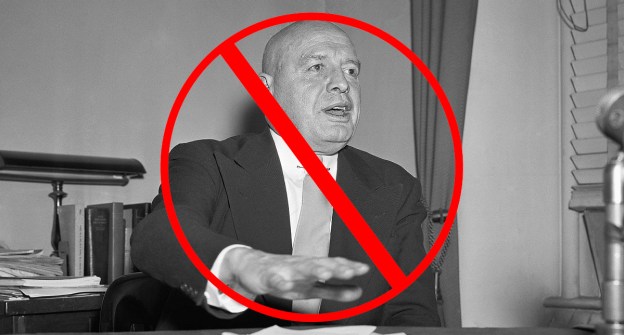
During my research, I discovered that there’s a DEA Museum unsurprisingly owned by the DEA (Drug Enforcement Administration). The museum has a website that features some of their exhibits. The one that caught my eye is dedicated to the first commissioner of the Federal Bureau of Narcotics (a precursor to the DEA) — Harry J. Anslinger.

All of this sounds pretty mundane until you consider the fact that Anslinger was a dedicated racist. Worse, the DEA Museum has completely whitewashed his racism from their website. Nary a mention of how he sold the War on Drugs using race, or any of his famously racist quotes.

Without getting into too much detail about Anslinger’s racism (covered in greater depth in Part I of the War on Drugs), I’ll leave a few quotes:

Reefer makes darkies think they’re as good as white men.

There are 100,000 total marijuana smokers in the U.S., and most are Negroes, Hispanics, Filipinos and entertainers. Their Satanic music, jazz and swing result from marijuana use. This marijuana causes white women to seek sexual relations with Negroes, entertainers and any others.

Colored students at the Univ. of Minn. partying with (white) female students, smoking [marijuana] and getting their sympathy with stories of racial persecution. Result: pregnancy.

…the increase [in drug addiction] is practically 100 percent among Negro people.

Two Negros took a girl fourteen years old and kept her for two days under the influence of hemp. Upon recovery she was found to be suffering from syphilis.

Their satanic music is driven by marijuana, and marijuana smoking by white women makes them want to seek sexual relations with Negroes.

Anslinger was so petty of a man that he directed his agents to arrest Billie Holiday in her hospital bed as she lay dying from liver and heart disease. Of course, you won’t find that on the DEA Museum’s website. You won’t find any of the quotes listed above, either. Nor will you find any mention of how he sold the War on Drugs using fears of race and race-mixing.

According to the DEA’s narrative, Anslinger was a saint of government service. As Americans, we should be ashamed that a taxpayer-funded entity has completely whitewashed his racist past.

I’ve archived the site in its present form as of 06/29/2020 here.

The War on Drugs – Part I

The Beginning

The War on Drugs started much earlier than most people think. The first salvo on the War on Drugs was the Smoking Opium Exclusion Act of 1909. Opium was banned for recreational purposes. The next volley was the Harrison Narcotics Act of 1914, which regulated and taxed cocaine and heroin. Additional laws adding further restrictions and bans were passed through the 1920s.

The true start of the War on Drugs was the creation of the The Federal Narcotics Bureau (a precursor to the DEA) in 1930. At that time it wasn’t an independent agency as we see The real start of the War on Drugs was the creation of The Federal Narcotics Bureau (a precursor to the DEA) in 1930. At that time, it wasn’t an independent agency, as we see with the DEA today; it was part of the Treasury Department. On paper, the agency was tasked with going after untaxed income from drugs, not the drugs themselves. But there’s a catch. You couldn’t obtain the tax stamps; they didn’t exist. Because there were no tax stamps, it was an effective ban on the sale and possession of the drugs.

The key isn’t so much the bureau itself, but who they appointed to lead the agency as the first commissioner — Harry J. Anslinger.

Harry J. Anslinger

Anslinger didn’t do much at first as there wasn’t much to do. He sought to strengthen existing drug laws and add harsher penalties for non-compliance. Anslinger’s essential problem was that there simply weren’t enough heroin and cocaine dealers and users to go after. So Anslinger did what so many bureaucrats do, which is to find a way to grow his power and scope. His first target was cannabis.

Now you may be asking, “How exactly is that racist?” At this point, it’s probably best to leave you with a few quotes to get an idea of the type of man Anslinger was.

Reefer makes darkies think they’re as good as white men.

There are 100,000 total marijuana smokers in the U.S., and most are Negroes, Hispanics, Filipinos and entertainers. Their Satanic music, jazz and swing result from marijuana use. This marijuana causes white women to seek sexual relations with Negroes, entertainers and any others.

Colored students at the Univ. of Minn. partying with (white) female students, smoking [marijuana] and getting their sympathy with stories of racial persecution. Result: pregnancy.

…the increase [in drug addiction] is practically 100 percent among Negro people.

Two Negros took a girl fourteen years old and kept her for two days under the influence of hemp. Upon recovery she was found to be suffering from syphilis.

Harry J. Anslinger

Ain’t he a peach?

War on Cannabis

Beginning around 1934, Anslinger ramped up the Appeal to Fear rhetoric against cannabis. Here are some of his quotes around that time period.

Marijuana is the most violence-causing drug in the history of mankind.​

You smoke a joint and you’re likely to kill your brother.​

Some people will fly into a delirious rage, and they are temporarily irresponsible and may commit violent crimes. Other people will laugh uncontrollably. It is impossible to say what the effect will be on any individual.

Harry J. Anslinger

Anslinger went to Congress and did the typical song and dance we see today. Present the outlier cases (or completely fabricate the narrative), have the “victims” testify to Anslinger went to Congress and did the typical song and dance we see today. Present the outlier cases (or completely fabricate the narrative), have the “victims” testify to Congress in typically weepy fashion, draft the bill, and have it pushed through. The result of this song and dance was the Marihuana Tax Act of 1937. Following the same template used for heroin and cocaine, the law required a tax to be paid on sales, denoted by a tax stamp. Like cocaine and heroin, the stamp didn’t exist, making all sales illegal.

You may be wondering why cannabis has taken on the name marihuana in government documents. Well, Anslinger was an equal opportunity racist. By changing to the Spanish name, he could also gain from anti-Mexican sentiment.

Anslinger’s claims regarding cannabis did not go unchallenged. In 1939, New York City Mayor Fiorello La Guardia set up a commission to study the effects of “marihuana.” The La Guardia Committee’s report refuted every claim that Anslinger had made.

Anslinger was enraged and went on the offensive. He claimed the study was “unscientific.” Anslinger did what bureaucrats do when they’re threatened. He rallied the sympathetic side of the press and worked behind the scenes to debunk and bury the report. Given that we still have a federal ban on cannabis, he was successful.

Target: Jazz

If you combine his “marijuana is violence” rhetoric with his racist speech, it’s pretty clear who Anslinger was targeting. Keep in mind that this man was the head of the Federal Narcotics Bureau for 32 years. You don’t think that the agency wasn’t ingrained with racism at its very core?

His racism was quite profound, and it permeated his words and actions. In Chasing the Scream: The First and Last Days of the War on Drugs, Johann Hari writes:

“Jazz was the opposite of everything Harry Anslinger believed in. It is improvised, relaxed, free-form. It follows its own rhythm. Worst of all, it is a mongrel music made up of European, Caribbean and African echoes, all mating on American shores. To Anslinger, this was musical anarchy and evidence of a recurrence of the primitive impulses that lurk in black people, waiting to emerge. ‘It sounded,’ his internal memos said, ‘like the jungles in the dead of night.’”

Chasing the Scream: The First and Last Days of the War on Drugs by Johann Hari

To further his goals, he targeted prominent black entertainers to make an example out of them. The first targets to incur his wrath? Jazz musicians. Jazz was growing in popularity and nothing like some high profile arrests of a group he hated to make his agency look good. Most famously he waged war on Billie Holiday. Billie Holiday was never silent about the racism she experienced in her life, and as a result, she became Anslinger’s favorite target.

Holiday started using heroin in the 1940s, and when Anslinger caught wind of that fact, he had an agent assigned to tail her and frame her buying or using heroin. Holiday was first arrested in 1947 and sentenced to a year in prison where she had to go cold turkey. As a result of her arrest, she lost her cabaret license and was unable to sing anywhere where alcohol was served.

To get an idea of the depth of Anslinger’s hatred, he even had her arrested while she was dying at New York’s Metropolitan Hospital of liver and heart disease in 1959. Anslinger ordered agents of the Federal Bureau of Narcotics to arrest her for drug possession.

Billie Holiday wasn’t his only target. Other jazz luminaries such as Ray Charles, Chet Baker, and Sonny Rollins were all arrested, convicted, and sent to the Lexington Prison Farm to clean up.

The treatment of entertainers wasn’t even-handed. Judy Garland was also addicted to heroin and other drugs and was handled with kid gloves.

With informants planted all over Hollywood, Anslinger knew what drugs Garland was doing and where she was getting them, so one day he intervened by visiting the heads of MGM and insisting they send her to a sanatorium, saying, “I believed her to be a fine woman caught in a situation that could only destroy her.” He was told they had $14 million invested in her and had no intention of giving her the time off she needed. An unsuccessful suicide attempt—even if only a cry for help—finally persuaded them that the best way to protect their investment was to send her to rehab. Later, Anslinger would imply that he had played the major role in helping Garland get clean, but that may also have been just a story only he believed.

America’s War on Drugs Has Treated People Unequally Since Its Beginning – Time Magazine

The End of Harry’s Reign, but not the War.

In 1962 after 32 years as the head of the Bureau of Narcotics, Anslinger retired at the mandatory retirement age of 70. Contrary to rumors, he was not ousted by Kennedy. Kennedy asked him to stay on until they could find a successor. As we all know, the War on Drugs has not only persisted but has escalated. The first escalation happened a mere eight years later under Richard Nixon. That is a story for Part II of the series.

Causes of Systemic Racism

In my last post about systemic racism, I provided ample evidence that there is indeed systemic racism in the criminal justice system. That said, it’s don’t hate the playa, hate the game. What that means is that I’m not blaming law enforcement officers as much as the system. The laws themselves are biased; cops have too much power and little accountability. This is the system they work within.

Population Density and the Inner City

As a few readers pointed out in the last post, some of the data can be due to Black Americans living in higher density areas. Now you may be thinking, “How does that contribute to systemic racism?” Without going too deep down the rabbit hole, the clustering Black Americans together is not an accident. The federal government created much of that problem with racist housing regulations. [cm_simple_footnote id=”1a”][cm_simple_footnote id=”2″]

The clustering can best be visualized by looking at the Racial Dot Map. What is clear in many cities is the sharp dividing line between black and white (Detroit as a prime example).

Implicit Bias

There have been many hypotheses as to why there is systemic racism; one of the more recent theories has been implicit bias. In a study[cm_simple_footnote id=”3″] by Michael Siegel M.D., M.P.H., he used data on fatal police shootings and ran it against five key indicators of systemic racism in each state; racial segregation, incarceration rate gaps, educational attainment gaps, the economic disparity index, and employment disparity gaps. He concluded:

Our findings provide evidence that both the threat hypothesis and the community violence hypothesis are contributing to the explanation of the striking racial disparity in police shootings of unarmed suspects. 

The Relationship Between Structural Racism and Black-White Disparities in Fatal Police Shootings at the State Level
Michael Siegel M.D., M.P.H.

Officer Performance Rating

Another factor listed as part of the cause is how police officers are rated as part of their performance. While quotas are illegal in most states, officers are still required to write tickets and make misdemeanor arrests (for things like drug possession). The loophole is that such metrics may be considered as a part of an officer’s overall performance review. Not reduced crime. Not reduced accidents. Not reduced complaints. Not improved community relations. Tickets and arrests. Why? Revenue generation. Law enforcement officials are less concerned with community relations and reduced crime than they are generating revenue for their agency.[cm_simple_footnote id=”4″]

Many cities have come under fire for such policies, including New York and their infamous “stop-and-frisk” policy. In 2012, Officer Craig Matthews spoke out about the policy saying:

…causing unjustified stops, arrests, and summonses because police officers felt forced to abandon their discretion in order to meet their numbers.

Officer Craig Matthews, NYPD

Consequently, the city retaliated against Officer Matthews by “punitive assignments, denial of overtime and leave, separation from his career-long partner, humiliating treatment by supervisors, and negative performance evaluations.” as claimed in a lawsuit Officer Matthews filed against the city.[cm_simple_footnote id=”5″] In 2015, the city settled the lawsuit for $280,000.[cm_simple_footnote id=”6″]

While these tactics may go unnoticed in the suburbs where the population is less dense, it becomes more problematic where the population is more racially dense. This effect was called out in the DOJ’s Ferguson Report.[cm_simple_footnote id=”7″] Officers assigned to the more racially dense Black neighborhoods, will naturally write more tickets and make more arrests of black Americans.

Conclusion

Systemic racism is not caused by any one factor, but a combination of many. I began with population density of Black Americans for a reason. It is that density that has some cascade effects down the line. Implicit bias and ticket quotas all feed into the population density and clustering that was baked into the system early on.

While these other factors may have a role, the single biggest factor of systemic racism in the criminal justice system is the War on Drugs. The Drug War from it’s inception in 1930 was specifically targeted against Black Americans. The War on Drugs was sold to white America using racist terms and imagery, and the laws were targeted toward Black Americans. Accordingly, the criminal justice system used the power they were granted to devastating effect. Exactly how it was designed

To better understand the War on Drugs, it is necessary to dig into the history of the Drug War. How the war began, who were the major players behind it, and the lasting effects it has today. That is something for Part IV.

Systemic Racism?

In the wake of the murder of George Floyd, there’s a lot of talk about systemic racism, especially in regards to the criminal justice system. What does that mean? Though some may disagree, it does not mean (nor am I implying) that police officers are racist. Statistically speaking, some are racist, most are not. That said, what systemic racism means is that the criminal justice system is tilted against Black Americans. Let’s investigate if that is indeed the case.

The Data

Traffic Stops

As many public interactions with police are a result of traffic stops, it’s useful to examine the data from the Bureau of Justice Police-Public Reports on Traffic Stops.

The table below lays out traffic and street stops as a percentage of all contacts with police. For context, white Americans make up 67% of the total driving population, and Black Americans make up 11%. Six times as many white Americans driving as Black.

Overall, 8.6% of all contacts with police were a result of traffic stops, 2.4% with the passenger was part of the stop, and 1% were from street stops. Also important is the number of arrests that resulted from the stops.

Nearly ten percent of Black drivers were subjected to traffic stops in 2015, compared to 8.6% for whites. Also notable are the higher percentage of street stops and the arrest rate.

EDIT: As one of my intrepid readers so gleefully observed while accusing this post of being slanted, whites are stopped 5 times as much as blacks. But the spreadsheet only shows a percentage of drivers of a race being stopped to make you think that’s an issue. Of course, he didn’t fully do the math. There are 6 times as many white drivers as black drivers so you’d expect if all things were equal, there would be 6 times as many traffic stops.,..not 5 times as many. Still not equal so the point is still valid.

Non-lethal Use of Force

With the increased police interactions, the next question is how are those interactions handled. A study by economist Roland G. Fryer, Jr. provides some insight.

“The results obtained using these data are informative and, in some cases, startling. Using data on police interactions from NYC’s Stop and Frisk program, we demonstrate that on non-lethal uses of force – putting hands on civilians (which includes slapping or grabbing) or pushing individuals into a wall or onto the ground, there are large racial differences. In the raw data, blacks and Hispanics are more than fifty percent more likely to have an interaction with police which involves any use of force.

An Emperical Analysis of Racial Differences in Police Use of Force
Roland G. Fryer, Jr.

The study found that the results were consistent across various data sets (different police departments).

Unarmed Fatal Interactions with Police

In Part I of this series, I presented a study that showed 20% of all fatal encounters with police involve unarmed citizens. That review also focused on race-gender differences in fatal encounters with police.

Using hierarchical linear models, we find the odds that black Americans will be killed by police when unarmed are nearly 7 to 1—more than double the odds found in research to date—and due primarily to the unarmed status of black women.

Race, Gender and the Contexts of Unarmed Fatal Interactions with Police” Johnson Jr, Gilbert, Ibrahim[cm_simple_footnote id=”1″]

A government study published in 2018 titled “Deaths Due to Use of Lethal Force by Law Enforcement“[cm_simple_footnote id=”2”] concluded:

Victims were majority white (52%) but disproportionately black (32%) with a fatality rate 2.8 times higher among blacks than whites. Most victims were reported to be armed (83%); however, black victims were more likely to be unarmed (14.8%) than white (9.4%) or Hispanic (5.8%) victims.

One thing of note, the data used in the first study presented was from 2013-2015, the 2nd was from 2009-2012, which may account for the statistical discrepancies. Nonetheless, it is clear from both studies than unarmed black males are far more likely to die at the hands of law enforcement than whites or Hispanics.

The Washington Post compiled a database on lethal use of force by law enforcement from 2015-2019 (unfortunately behind a paywall), but this graphic from their study shows the same pattern.

Drug Arrests/Convictions

Whites and blacks use illegal drugs in roughly equal numbers relative to percentage of population[cm_simple_footnote id=”3″].

Side rant: While researching these statistics, the most useful site for crime demographics was the FBI’s Crime in the United States 2018. It has all the demographic information you’d want for all crimes with one notable exception… drug arrests. This was the only demographic provided there…which is utterly useless. 

However, the Bureau of Justice provides incarceration rates for drug offenses. The spreadsheet shown below shows that blacks as a percentage are once again higher than whites.

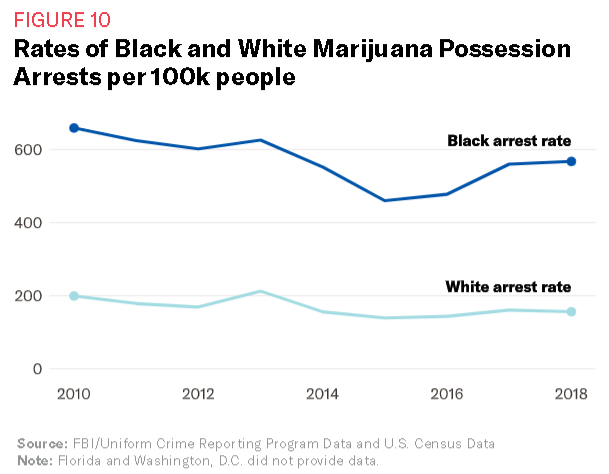
This pattern is repeated with cannabis, a non-addictive drug, and one that most rational people don’t consider dangerous (with many states decriminalizing or legalizing marijuana for recreational use). Below is a chart showing drug usage statistics comparison by race from the Substance Abuse and Mental Health Services Administration (SAMHSA).

Now compare that to arrests by race using the FBI Uniform Crime Reporting.

Gee, the use and arrest/convictions doesn’t line up, does it?

What is both interesting and disturbing are the trends regarding drug arrests. Arrests for drug possession of increased while arrests for drug sale/manufacturing have been flat since 1997. This image from an analysis of the Bureau of Justice Statistics and Uniform Crime Report.[cm_simple_footnote id=”4″]

It’s almost like they’re not even trying to “stop” illegal drug sales.

Civil Asset Forfeiture

The abuses of civil asset forfeiture have been widely reported. Civil asset forfeiture has been proven to disproportionately affect minorities and the poor. There are numerous studies and reports on this issue here, here, and here. With Philadelphia as the poster child for civil asset forfeiture abuse, here.

In 2018, a consent decree agreement with the City of Philadelphia was announced. The result of that agreement is that the city will have tight restrictions on when they can seize assets. It was further agreed that the city would pay reparations to those victimized by civil asset forfeiture.[cm_simple_footnote id=”5″] 

Conclusion

I went into researching this post with an open mind. The goal was to analyze the raw data, consult scholarly studies, and form a rational position based on the data.

This post examined traffic stops, non-lethal use of force, fatal interactions with police, and drug arrest convictions/incarceration rates. It also touched on civil asset forfeiture and who is most affected by it. The totality of the evidence is simultaneously enlightening and depressing.

While Mark Twain famously popularized the saying, “lies, damn lies and statistics,” the data is pretty damning when it comes to the existence of systemic racism in our criminal justice system.

The big question is “why?”. That is something I’ll tackle in Part III.

The Murder of George Floyd – Minimization

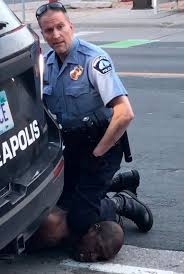
The murder of George Floyd at the hands of Minneapolis Police officer Derek Chauvin has aroused a range of emotions across the country. Some are sympathetic, some are enraged, some are defensive, and inexplicably…some are in outright denial. As it took me some time to carefully research and consider the facts before writing this post, it will be broken up into a series.

Victim-blaming

I’ve seen far too many people resort to victim-blaming to minimize what happened. It does not matter who George Floyd was, what his criminal history was, what drugs were in his system, and the reasons for his arrest. None of these things are the least bit relevant. Anyone making that claim is using a red herring logical fallacy. I’ve seen memes and commentators attempting to make that same point. As an example, Candace Owens went on a long rant about attacking George Floyd’s character which was brilliantly deconstructed by Larry Sharpe. [cm_simple_footnote id=”1″] Nobody is making George Floyd out to be a “hero” but he has become the face of a cause.

The fact of the matter is that law enforcement has a duty to the care and well-being of an individual in custody.[cm_simple_footnote id=”2″] [cm_simple_footnote id=”3″] Make no mistake, Floyd was in custody. He was lying prone while handcuffed. If he was resisting at some point off-camera (and I’ve seen and heard nothing that indicates he was), it’s pretty clear he had stopped. You simply cannot defend a police officer kneeling on a man’s neck for 8 minutes and 46 seconds by stating that the victim was not an upstanding citizen. He was a human being, a U.S. Citizen and at a minimum was entitled to due process for his alleged crime.

Unarmed White Individuals killed by law enforcement

The other common red herring I’d like to address are the posts, memes, and commentaries about unarmed white men being killed by law enforcement as a way to minimize the racial component and the BLM movement. Typically, these posts like to point out that people did not protest or riot (SIDE NOTE: Protesters are not rioters) over the deaths of unarmed white individuals (like Duncan Lemp, Daniel Shaver, Tony Timpa, and Kelly Thomas) at the hands of law enforcement. Well gee America, how noble of you to remain silent while your unarmed white brothers are killed by law enforcement. Where was your outrage when these men were killed at the hands of law enforcement? Where are the posts pointing out their criminal histories? Are you trying to say you didn’t care about those deaths but only care now to bring them to everyone’s attention because…”All Lives Matter.” Outside of civil libertarians, nobody else was showing outrage or concern that unarmed citizens have been and are being killed by law enforcement.

Missing the Point

All of these fallacious arguments miss the point. We should ALL be outraged when ANY individual dies at the hands of law enforcement while unarmed. Their criminal histories do not matter. Whatever drugs are alcohol they were on do not matter. More disturbing is the fact that 20% of all fatal encounters with police involve unarmed citizens.

Table 1 (see chart below) provides descriptive information of the agency sample and the sample of fatalities. Our samples reveal that a fifth (20%) of all fatalities were of unarmed individuals (column 3), and that they were committed by approximately 9 percent of the (law enforcement) agencies in our sample (column 1).

“Race, Gender and the Contexts of Unarmed Fatal Interactions with Police” Johnson Jr, Gilbert, Ibrahim[cm_simple_footnote id=”4″]

The first step in solving any problem is admitting there is a problem. Resorting to logical fallacies to minimize the problem is not going to solve a thing. At some point Americans need to come to terms with the facts on fatal police interactions. In my next post I’ll address the racial component and if there is systemic racism in law enforcement.

Part II

Principles and Pragmatism

I’ve been voting for Libertarian Party candidates for 26 years. That’s a lot of write-in candidates over the years. I fully stand on our principles but the fact of the matter is that the Libertarian Party has not made a substantive impact on American Politics since it’s founding.

What are our goals as a party? Do we want to effect real change? Do we want to make an impact on policy? Are we satisfied merely being a protest vote? Or do we want to continue to founder on our hard-line principled high ground only to criticize the duopoly for their folly? Honestly, I’m tired of that as I’ve been doing it for the better part of my adult life. I want to see this party grow and make a real impact on American politics.

Clearly, people are fed up with the two-party system. The Democratic and Republican party registrations are shrinking and independents make up the largest voting bloc. There’s a real opportunity here for a 3rd-party to make a real impact.

So why haven’t we made an impact?

You could point to several external factors. The CPD keeping us out of the debates. The duopoly tilting the system against us. The winner-take-all voting structure. You could say “everything will be better if we change to ranked-choice, STAR, or SCORE voting” or “If we could only get into the debates!” Yes, those are all factors. But they’re really excuses.

The truth of the matter is we’re our own worst enemies.

Why?

Because we have consistent principles, we tend fall back those principles in any political conversation. We think our principles are simple while our detractors have made simple memes about “What about the roads?” and “Somalia, libertarian paradise.” The truth of the matter is that our ideas are not that simple to explain in application to a world now accustomed to bite-size morsels of media, memes, and slogans.

In my opinion the other way we hurt ourselves is that too many people in this party are tone-deaf when it comes to our image. We don’t care how we appear to non-libertarians…even those that we could attract to the party. We should be looking at independents and moderates from either party as potential libertarians. We just need to sell them on ideas, then explain the principles behind those concepts. We tend to do it the other way around. We explain the principles, then how it applies. People just really want to know what we want to do but they are not ready for the end goals. It’s actually beyond their comprehension.

Too often I feel that there are people in the party that treat the LP like the Cool Kids Club. That if you don’t take a hard-line on principles, then you’re booed at our conventions or excoriated on social media. The attitude seems to be, “This is who we are, screw you if you don’t like it.” This is not furthering our cause.

These flaws are all fine and dandy if you want the Libertarian Party to continue to be nothing more than a protest vote. I’m tired of the protest vote when I believe we’re capable of so much more. We have to be willing to change…to be more self-aware. Being a pragmatist does not mean sacrificing principles. The end goal is still the same. Where pragmatists and hardliners diverge is how we get there and how we present ourselves to the American public.

The fact of the matter is that the American public has been indoctrinated for decades that government is the solution to whatever problems Americans think need to be solved. You can’t undo that with a snap of the fingers and stroke of the pen. Undoing the damage from this mindset will take decades. The American people aren’t ready for that. So how do we get there?

I can tell you how we won’t get there. By maintaining a hard line. By giving serious consideration and nominating candidates that a majority of Americans would consider to be a joke. At that point, you can’t even counter the “lesser of two evils” argument with a majority of Americans. How we position ourselves and how we sell ourselves matters as much as anything when it comes to candidates…that’s been true since the first televised debates with Nixon vs. Kennedy.

The way to real change is to move everything to a more libertarian position. By selling our libertarian principles in a way that resonates with the American people. Things like ending foreign wars, shrinking the military, balancing the budget, legalizing marijuana, reducing police power, decreasing regulation, ending bailouts, reducing crony capitalism, etc. But we can’t do that by sticking to the hard-line. Slogans like “End the Fed” and “Taxation is Theft” while correct on principle, are lost on a majority of Americans.

I don’t consider libertarianism to be a joke and It shouldn’t be merely a protest vote. It’s something that I believe is the only thing that can save America from itself. It is possible to be principled and pragmatic so long as our end goals are the same. We need to be cognizant of how we present libertarian ideas to others in order to sell the party as a legitimate option. The rest of the time we can continue to argue amongst ourselves as is tradition. 😀