
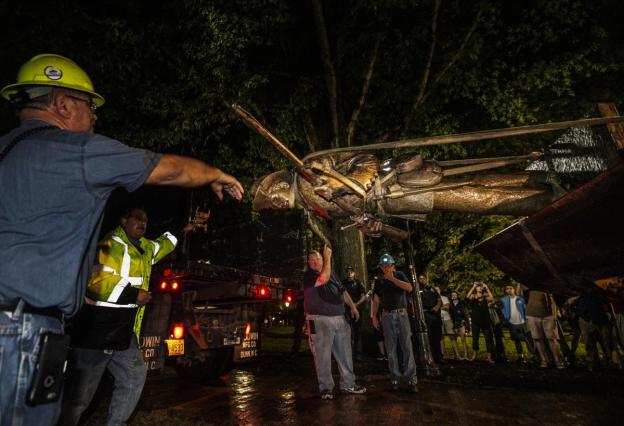
One of the side-effects of the BLM protests has been the outrage over Confederate statues. The common theme in some circles is the removal of these statues is an attack on Southern history. That premise assumes that the statues are there to honor Southern heritage and those that served and died in the Civil War. The reality is that they were erected to support a cause, but not that cause you may think.
Who raised the majority of the Confederate Monuments and Statues?
Many people may be surprised to learn that most of these Confederate monuments and statues were erected more than 35 years after the Civil War ended. Wikipedia has a partial list here. By one count more than 700 have been raised since 1900.
Who was responsible for building all these monuments and statues? Why were they raised so long after the Civil War? What was the motivation behind them? Enter the United Daughters of the Confederacy.
United Daughters of the Confederacy
If you go to Wikipedia, you’ll find The United Daughters of the Confederacy (UDC) is labeled as a hate group by the Southern Poverty Law Center (SPLC). I don’t put much stock in the SPLC these days as they tend to subjectively label groups as hate groups for merely having conservative views. Time to dig a little deeper.
Who are the UDC? According to Wikipedia, they are an “American hereditary association of Southern women established in 1894 in Nashville, Tennessee.” That doesn’t tell us much. In their Proclamation Statement, they state the following:
The United Daughters of the Confederacy® is an Organization dedicated to the purpose of honoring the memory of its Confederate ancestors; protecting, preserving and marking the places made historic by Confederate valor; collecting and preserving the material for a truthful history of the War Between the States; recording the participation of Southern women in their patient endurance of hardship and patriotic devotion during and after the War Between the States; fulfilling the sacred duty of benevolence toward the survivors and those dependent upon them; assisting descendants of worthy Confederates in securing a proper education; honoring the service of veterans from all wars as well as active duty military personnel and cherishing the ties of friendship among the members of the organization
United Daughters of the Confederacy – Proclamation Statement
What is interesting to me is this phrase: “…preserving the material for a truthful history of the War Between the States.” “Truthful history?” What is their version of “truthful?” “War Between the States?” Interesting way to phrase it, most people would call it the “Civil War.” Why would they use that terminology? The UDC’s interpretation of truth is of great importance as it’s a foundation for what they do and why they do it.
In order to understand the UDC’s “truth,” a little background information is necessary
The Lost Cause
The Lost Cause of the Confederacy or just the “Lost Cause” is an alternate version of the Civil War that began during the Reconstruction. In this telling of history, the Confederates were fighting for States’ Rights (debunked in a previous post). They were fighting for nobility and chivalry of the South. This version also claimed that slaves were well-treated by their masters and that the South were victims of the North infringing on their rights. In this view, the Civil War was a just and noble cause.
How did this alternate version of reality become so common?
The Lost Cause and the UDC
One of the UDC’s primary goals was educating the youth of the South on their version of history. This goal was first was documented in 1899 at the UDC’s Annual Convention. From their Meeting Minutes at that convention:
The Historical Committee has been actively at work and has called to their aid the Veterans, asking them to read the different histories and to report which are true and which are false; asking lectures from them on the true relation of “ master and slave,” picturing life on the plantation, and causing the young to know that “Uncle Tom’s Cabin” is not a true picture, but a frightful distortion of the truth by one prejudiced against every Southern institution. I am proud to note the number of histories written by Southern authors, demonstrating the fact that we are now not only makers of history, but writers as well, and that several Daughters of the Confederacy are writing history, truthfully telling the grand place the South has always had in our country’s history.
Combined with this:
As shown, we have entered into the obligation of “collecting and preserving” material for a truthful history of the Civil War and of making a “determined” effort to have a “truthful” history taught in public schools of the State, and to use our influence toward attaining this object in all private schools. Shall we, the daughters of those who always conformed to the Constitution of their country, and who fought and died with the hope of preventing the subversion of that Constitution—shall we be unmindful of the obligations which we have assumed under the Constitution of our association? Noncompliance is virtual subversion. Shall we not guard with jealous care our great bulwark, Moral Obligation, lest the now southward-flowing, sinuous stream, Do-as-you-please, sap the very foundation of the political and social structure erected by the men of the South?
Clearly, the UDC wishes to promote their version of “truth.”
In 1904, the UDC further pushed the goal with the Texas Chapter of the UDC’s Catechism for Children. The claims made in the document are that the North sold slaves to the South (as they were unprofitable) and then declared an “Abolitionist Party” to deny payment to the South. It further asserts that the South was opposed to slavery, but the U.S. Constitution included it, so they just went along with it. Here are a few of the ridiculous claims of this fantastical version of history is as follows:
[13] How were the slaves treated?
With great kindness and care in nearly all cases, a cruel master being rare, and lost the respect of his neighbors if he treated his slaves badly. Self interest would have prompted good treatment if a higher feeling of humanity had not.
[14] What was the feeling of the slaves towards their masters?
They were faithful and devoted and were always ready and willing to serve them.
[56] Was the Confederate army defeated?
No; it was overpowered by numbers, and its resources exhausted.
The last one is rather amusing. Generally, that’s how armies are defeated.
A good example of a textbook promulgating the Lost Cause version comes from Young People’s History of North Carolina by Daniel Harvey Hill Jr and published in 1907.
The negro slaves lived in cabins, called the quarters, near the master’s house. Their wants were supplied from the family store-house. In sickness they were attended by the family doctor and their medicine was given by some member of the master’s family. As a rule the slaves were comfortably clothed, given an abundance of wholesome food, and kindly treated. Occasionally some hard-hearted master or bad-tempered mistress made the lot of their slaves a hard one, but such cases were not common. Cruel masters and cruel mistresses were scorned then just as men and women who treat animal’s cruelly are now scorned . These slaves were brought into the colonies fresh from a savage life in Africa and in two or three generations were changed into respectable men and women. This fact shows, better than any words can, how prudently and how wisely they were managed.
In 1919, a commission was created to advance the “Lost Cause” in education with members of the United Confederate Veterans (UCV), Sons of Confederate Veterans (SCV), and the UDC. The commission was called the Rutherford Commission after its leader, Mildred Lewis Rutherford.
Mildred Lewis Rutherford was an educator and author. She was also the Historian General for the UDC. Given her standing in the UDC, it’s not a surprise that Mildred was pro-Confederacy. She believed that the South were victims in the “War Between the States,” she defended slavery and praised the Ku Klux Klan. Mildred thought that the textbooks should reflect the Lost Cause version (the UDC’s “truth”) of the Civil War. All of these topics are covered an address she made in 1914 called Wrongs of History Righted.
The Rutherford Commission published a standard for textbooks in 1919 called A measuring rod to test text books, and reference books in schools, colleges and libraries. Rutherford followed up that work with Truths of History, which added to the “measuring rod” and added a blacklist of books that did not tell the UDC’s Lost Cause “truth.” The result of the publication is that several textbooks were banned in the South.
The Lost Cause today?
The Lost Cause narrative has been in place in southern schools over nearly 120 years and has only been recently eliminated (in Texas, the last vestiges of the Lost Cause were removed in 2018, yes…2018). And we wonder why we’re still having discussions about race in 2020? What do you think happens when you teach generations that the Civil War was not about slavery it was about States’ Rights, that slaves were well-treated, and the cause was just and righteous?
It’s pretty clear that no matter how the UDC spins themselves today, they’re an organization that has consistently supported a racist retelling of the history of slavery in the South and the Civil War.
Heritage? No. Lost Cause? Yes.
Now we have the who and the why, but what about the timing? Why were so many statues and monuments erected between 1900-1960? Quite simply, to further the Lost Cause and support Jim Crow. Worse, as a cruel reminder to Black Americans to know their place.
These statues and monuments are not about history. They’re not about heritage any more than the Confederate Flag is about heritage. These statues and monuments were not erected by the UDC to honor the veterans of the Civil War. They were erected to honor the cause…the Lost Cause.
My thoughts
When I started researching this post, I didn’t have a clear position other than no government should maintain these statues or keep them on government property. After doing the research and discovering the real motivation behind the raising of the statues, my views have changed. I recalled the words of Ilya Somin in a post for Reason.com. It sums up my feelings and position rather well:
[R]emoving Confederate monuments does not require any “whitewashing” of history. No one claims that we should erase the Confederacy and its leaders from the historical record. Far from it. We should certainly remember them and continue to study their history. We just should not honor them.

 The Pragmatic Libertarian